





TL;DR: An OLAP (Online Analytical Processing) database is designed for fast, complex queries on large datasets and is commonly used for analytics, business intelligence, and reporting. Unlike OLTP systems, OLAP databases use columnar storage, pre-aggregation, and parallel processing to deliver sub-second query performance. Popular OLAP databases include ClickHouse, Apache Druid, Snowflake, BigQuery, and VeloDB, which support real-time analytics, high concurrency, and modern data workloads.
What Is an OLAP Database?
An OLAP database (Online Analytical Processing database) is a system optimized for analyzing large volumes of historical data using complex queries.
The primary goal of an OLAP database is to enable fast data analysis across multiple dimensions, such as time, geography, and product categories.
Unlike OLTP databases, which focus on processing transactions, OLAP databases are designed to:
- aggregate large datasets
- run complex analytical queries
- support business intelligence and reporting
This makes OLAP databases essential for organizations that rely on data-driven decision-making.
How OLAP Databases Work
OLAP databases are designed to process large-scale analytical queries efficiently by optimizing how data is stored, accessed, and computed.
They achieve high performance through several key techniques:
- Columnar storage: Instead of storing data row by row, OLAP databases store data by column. This allows queries to scan only the required columns, significantly reducing I/O and improving aggregation speed.
- Pre-aggregation and indexing: Frequently used aggregations (such as totals, averages, and counts) can be precomputed or indexed, enabling faster query responses for common analytical workloads.
- Massively parallel processing (MPP): OLAP systems distribute queries across multiple nodes or cores, allowing them to process large datasets in parallel and return results quickly.
- Query optimization engines: Modern OLAP databases use advanced query planners and optimizers to rewrite queries, reduce scan ranges, and improve execution efficiency.
- Separation of storage and compute (modern architectures): Many modern OLAP systems decouple storage from compute, enabling elastic scaling and better resource utilization.
Together, these techniques allow OLAP databases to scan billions of rows and return results in seconds—or even milliseconds.
Key Features of OLAP Databases
OLAP databases are specifically designed to support analytical workloads and business intelligence use cases. Their core features include:
- Columnar storage for analytics: Optimized for read-heavy workloads and aggregation queries, enabling faster performance compared to row-based systems.
- High-performance query execution: Capable of handling complex queries involving joins, aggregations, and filters across large datasets with low latency.
- Multidimensional analysis capabilities: Supports analyzing data across multiple dimensions such as time, geography, product, and user segments.
- Real-time and batch data ingestion: Modern OLAP systems support both traditional batch processing and real-time data pipelines, enabling up-to-date analytics.
- High concurrency and scalability: Designed to handle multiple users and queries simultaneously, making them suitable for dashboards and customer-facing analytics.
- Integration with modern data stacks: Compatible with data lakes, lakehouses, and streaming systems, allowing seamless integration into modern data architectures.
These features make OLAP databases essential for organizations that need fast, scalable, and flexible analytics on large datasets.
OLAP vs OLTP: Key Differences
| Feature | OLAP | OLTP |
|---|---|---|
| Purpose | Analytics and reporting | Transaction processing |
| Query type | Complex, long-running queries | Simple, short queries |
| Data volume | Large historical datasets | Small, real-time data |
| Storage | Columnar | Row-based |
| Examples | ClickHouse, Snowflake | MySQL, PostgreSQL |
While OLAP and OLTP databases are both essential components of modern data systems, they are designed for fundamentally different purposes.
OLTP (Online Transaction Processing) systems are optimized for handling large numbers of small, real-time transactions. These include operations such as inserting, updating, and deleting records—typical in applications like e-commerce checkouts, banking systems, or user authentication workflows. OLTP databases prioritize low latency, data consistency, and high write throughput.
In contrast, OLAP (Online Analytical Processing) systems are built for analyzing large volumes of historical data. Instead of handling transactions, they focus on complex queries, aggregations, and reporting. OLAP databases are commonly used in business intelligence dashboards, financial reporting, and data analytics platforms.
Another key difference lies in how data is stored and accessed. OLTP systems typically use row-based storage, which is efficient for transactional operations. OLAP systems, on the other hand, use columnar storage, which allows them to scan only relevant columns and significantly speed up analytical queries.
In modern data architectures, OLTP and OLAP systems are not competing technologies—they work together. Data is first generated in OLTP systems and then transferred to OLAP systems through ETL/ELT pipelines or real-time streaming (e.g., CDC). This separation allows each system to perform efficiently without compromising performance.
Understanding the differences between OLAP and OLTP is critical when designing data infrastructure, as choosing the wrong system for a workload can lead to performance bottlenecks or scalability issues.
When to Use OLAP vs OLTP
Choosing between OLAP and OLTP depends on the type of workload and the kind of questions you need to answer.
Use OLTP databases when your application requires fast, reliable transaction processing. These systems are ideal for scenarios where data is frequently created or updated, such as:
- user transactions (e.g., sign-ups, payments)
- order processing and inventory updates
- real-time operational systems (e.g., banking, e-commerce)
OLTP databases are optimized for low-latency writes, high concurrency, and data consistency, making them essential for day-to-day business operations.
Use OLAP databases when your goal is to analyze data rather than modify it. These systems are designed for:
- business intelligence and analytics
- reporting and dashboards
- trend analysis and forecasting
- large-scale data exploration
OLAP databases excel at running complex queries on large datasets, allowing organizations to uncover patterns, generate insights, and support data-driven decision-making.
In short, OLTP powers your operations, while OLAP powers your analysis.
How OLTP and OLAP Work Together
In modern data architectures, OLTP and OLAP systems are designed to complement each other rather than replace one another.
The typical workflow looks like this:
1. Data generation (OLTP systems)
Operational databases such as PostgreSQL or MySQL capture real-time data from applications—user actions, transactions, and system events.
2. Data movement (ETL / ELT / CDC)
Data is then transferred from OLTP systems to OLAP systems using:
- ETL / ELT pipelines for batch processing
- Change Data Capture (CDC) for real-time or near real-time synchronization
3. Data analysis (OLAP systems)
Once ingested into an OLAP database, the data is transformed, aggregated, and analyzed to support reporting, dashboards, and advanced analytics.
This separation of responsibilities allows each system to be optimized for its specific workload:
- OLTP systems handle high-frequency transactions efficiently
- OLAP systems handle large-scale analytical queries efficiently
As data systems evolve, this pipeline is increasingly becoming real-time, enabling organizations to move from batch analytics to near real-time insights.
Core Concepts of OLAP
Understanding the core concepts of OLAP helps explain how analytical queries can be performed so efficiently on large datasets.
Data Cubes and Dimensions
OLAP systems organize data into multidimensional structures known as data cubes, which allow users to analyze data from multiple perspectives.
A data cube typically includes:
- Dimensions – descriptive attributes used to segment data (e.g., time, region, product)
- Measures – numerical values that can be aggregated (e.g., revenue, count, profit)
For example, a sales dataset can be analyzed by:
- time (daily, monthly, yearly)
- region (country, city)
- product category
This multidimensional model enables flexible analysis without rewriting complex queries each time.
Common OLAP Operations
OLAP systems support several standard operations that make data exploration intuitive and efficient:
- Slice: Filters data along a single dimension (e.g., sales in 2025 only)
- Dice: Filters data across multiple dimensions (e.g., sales in 2025 for a specific region and product)
- Drill-down: Moves from aggregated data to more detailed levels (e.g., yearly → monthly → daily)
- Roll-up: Aggregates data to a higher level (e.g., daily → monthly → yearly)
- Pivot: Reorients data to view it from different perspectives (e.g., switching rows and columns in a report)
These operations allow analysts to explore large datasets interactively and uncover insights quickly.
Types of OLAP Systems
OLAP systems can be categorized into three main types based on how data is stored and processed.
ROLAP (Relational OLAP)
ROLAP systems store data in relational databases and use SQL queries to perform analysis.
- Uses star or snowflake schemas
- Scales well with large datasets
- Flexible and easy to integrate with existing systems
However, query performance may depend on indexing and optimization strategies.
MOLAP (Multidimensional OLAP)
MOLAP systems store data in precomputed multidimensional cubes, which are optimized for fast query performance.
- Extremely fast query response times
- Pre-aggregated data reduces computation at query time
However, MOLAP systems can be:
- less flexible
- harder to scale with very large datasets
HOLAP (Hybrid OLAP)
HOLAP combines the strengths of both ROLAP and MOLAP:
- Stores detailed data in relational tables (ROLAP)
- Stores aggregated data in cubes (MOLAP)
This approach balances performance and scalability, making it suitable for many enterprise use cases.
Modern Perspective on OLAP Types
In modern data architectures, the distinction between ROLAP, MOLAP, and HOLAP is becoming less rigid. Many modern OLAP databases use columnar storage, distributed processing, and real-time ingestion, blending characteristics of multiple models.
As a result, newer systems focus more on performance, scalability, and real-time analytics rather than strictly fitting into traditional OLAP categories.
Modern OLAP Databases (What Changed in 2026)
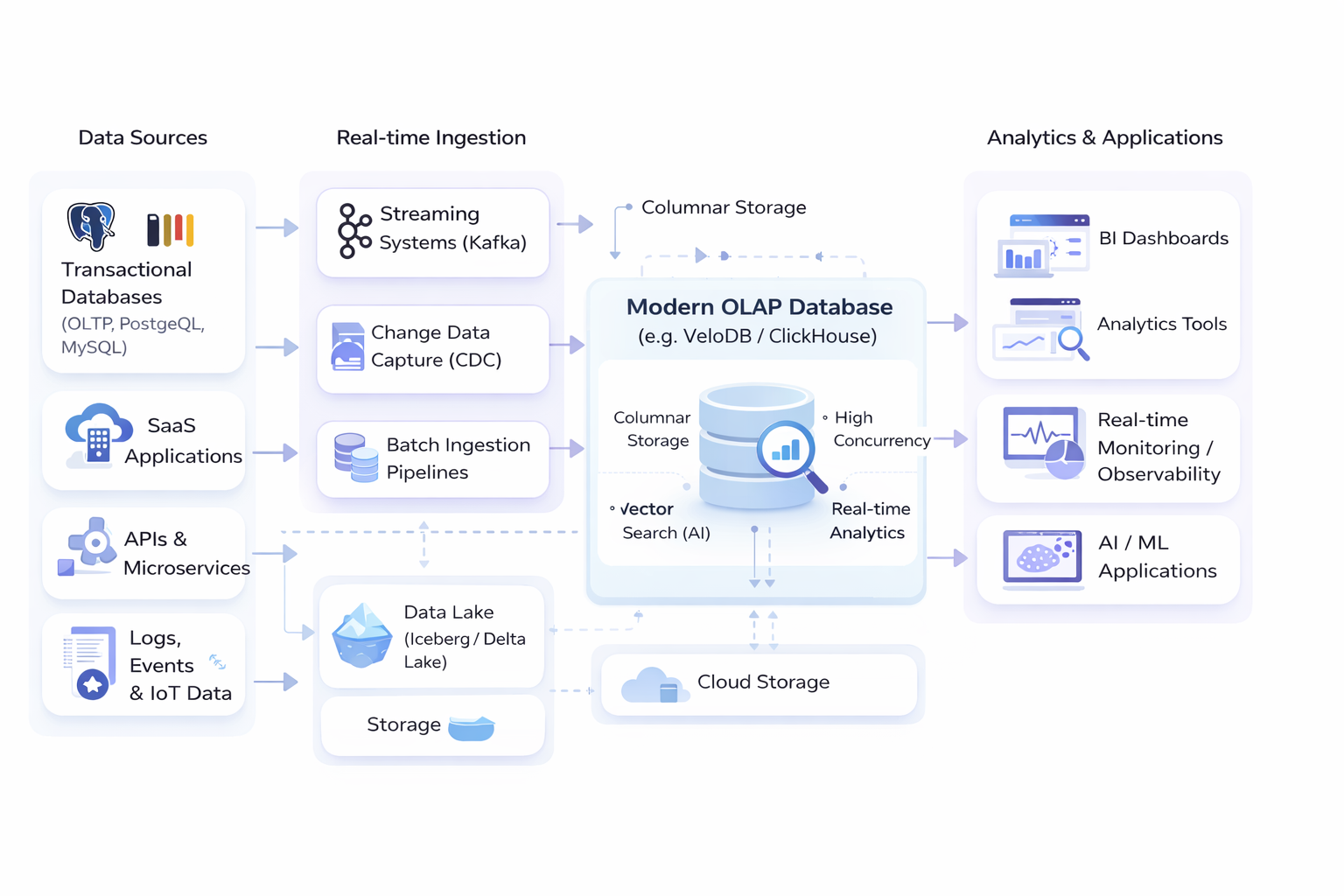 Traditional OLAP systems were primarily designed for batch analytics, where data is processed in scheduled intervals. However, modern data applications increasingly require real-time insights, high concurrency, and support for diverse data types, driving a significant evolution in OLAP database design.
Several key trends define modern OLAP databases:
- Real-time analytics and streaming ingestion: Modern OLAP systems can ingest and analyze data in real time using streaming pipelines and Change Data Capture (CDC), enabling near-instant insights instead of delayed reporting.
- High-concurrency query processing: Unlike traditional systems optimized for a small number of analysts, modern OLAP databases are designed to handle thousands of concurrent queries, making them suitable for dashboards and customer-facing analytics.
- Lakehouse integration and open table formats: Integration with technologies like Apache Iceberg and Delta Lake allows OLAP databases to query data directly from data lakes, reducing data duplication and simplifying architecture.
- Separation of storage and compute: Many systems decouple storage from compute, enabling elastic scaling and better cost efficiency in cloud environments.
- AI and vector search capabilities: With the rise of AI applications, modern OLAP databases increasingly support vector indexing and hybrid search, allowing them to power retrieval-augmented generation (RAG) and intelligent data applications.
- Unified analytics for structured and semi-structured data: Modern systems can handle JSON, logs, and event data alongside traditional structured data, enabling broader use cases such as observability and real-time analytics.
Modern OLAP databases such as VeloDB extend traditional capabilities by combining real-time ingestion, high-concurrency query execution, and hybrid search, making them suitable for both analytical and AI-driven workloads.
Best OLAP Database Examples & Tools in 2026
The best OLAP database depends on your data volume, query patterns, and real-time requirements. Below are some of the most widely used OLAP databases in 2026, each with different strengths and trade-offs.
ClickHouse
ClickHouse is one of the most widely adopted open-source OLAP databases, known for its extremely fast query performance on large datasets. It is commonly used for analytics, logging, and real-time dashboards.
Key features
- High-performance columnar storage engine
- Real-time ingestion and fast aggregation queries
- Strong ecosystem for analytics and observability
Considerations
- Requires operational expertise for large-scale deployments
- Query optimization and schema design can impact performance
Apache Druid
Apache Druid is designed for real-time analytics on streaming data, particularly for time-series and event-driven workloads.
Key features
- Real-time ingestion from streaming systems (e.g., Kafka)
- Fast time-series queries and aggregations
- Distributed architecture optimized for scalability
Considerations
- Best suited for event/time-series use cases
- Less flexible for general-purpose analytics
Snowflake
Snowflake is a cloud-native OLAP data warehouse that emphasizes ease of use, scalability, and managed infrastructure.
Key features
- Separation of storage and compute
- Fully managed, no infrastructure maintenance
- Strong support for SQL and data sharing
Considerations
- Costs can increase significantly with large data volumes
- Less control over underlying infrastructure
BigQuery
BigQuery is Google’s serverless OLAP database, designed for large-scale analytics with minimal operational overhead.
Key features
- Serverless architecture with automatic scaling
- Fast SQL queries on massive datasets
- Deep integration with Google Cloud ecosystem
Considerations
- Pricing based on data scanned can become expensive
- Performance tuning options are limited compared to self-managed systems
VeloDB
VeloDB is a modern OLAP database designed for real-time analytics, high-concurrency workloads, and emerging AI use cases.
Unlike traditional OLAP systems that rely heavily on batch processing, VeloDB enables real-time data ingestion and sub-second query performance, making it suitable for dynamic and data-intensive applications.
It is increasingly used in scenarios such as observability analytics, real-time dashboards, and AI data pipelines, where both speed and scalability are critical.
Key features
- Sub-second query performance on large-scale datasets
- High-concurrency query execution for interactive analytics
- Real-time ingestion for logs, metrics, and event data
- Support for hybrid analytical and search workloads
Considerations
- May require integration with visualization tools (e.g., BI dashboards)
- Best suited for large-scale or real-time analytics environments
Common OLAP Use Cases
OLAP databases are widely used in scenarios where organizations need to analyze large volumes of data and generate insights quickly.
Some of the most common use cases include:
- Business intelligence and dashboards: OLAP databases power BI tools by enabling fast queries for dashboards, reports, and executive summaries.
- Financial reporting and forecasting: Organizations use OLAP systems to analyze revenue, costs, and trends over time, supporting budgeting and strategic planning.
- Customer behavior and product analytics: OLAP databases help analyze user behavior, conversion funnels, and product performance across different segments.
- Observability and log analytics: Modern OLAP systems are increasingly used to analyze logs, metrics, and traces in real time, helping teams monitor system performance and troubleshoot issues.
- Real-time analytics applications: Applications such as recommendation systems, fraud detection, and operational monitoring rely on OLAP databases to deliver insights with low latency.
These use cases highlight how OLAP databases enable organizations to move from raw data to actionable insights at scale.
Benefits and Limitations of OLAP Databases
OLAP databases offer significant advantages for analytics workloads, but they also come with trade-offs that organizations should consider.
Benefits
- Fast analytical queries at scale: OLAP systems are optimized for scanning and aggregating large datasets, delivering fast results even on billions of rows.
- Scalability for growing data volumes: Distributed architectures allow OLAP databases to scale horizontally as data and query demand increase.
- Improved decision-making: By enabling deeper and faster analysis, OLAP databases help organizations make data-driven decisions with greater confidence.
- Support for complex queries: OLAP systems can handle joins, aggregations, and multidimensional analysis that would be inefficient in transactional databases.
Limitations
- More complex setup and data modeling: Designing schemas, pipelines, and aggregation strategies can require additional effort compared to OLTP systems.
- Slower write performance: OLAP databases are optimized for reads rather than writes, making them less suitable for high-frequency transactional updates.
- Not designed for transactional workloads: OLAP systems are not ideal for applications that require strict consistency and real-time updates (e.g., payment processing).
- Potential infrastructure and cost considerations: Large-scale analytical workloads may require significant compute and storage resources, especially without proper optimization.
How to Choose an OLAP Database
Choosing the right OLAP database depends on your specific workload, data architecture, and performance requirements.
Key factors to consider include:
- Data volume and growth: Consider how much data you need to store and how quickly it is growing. Some systems are better suited for petabyte-scale workloads.
- Query performance and latency requirements: Determine whether you need sub-second responses for dashboards or can tolerate longer query times for batch reporting.
- Real-time vs batch processing needs: If your use case requires real-time insights (e.g., observability or user analytics), choose a system with strong streaming and ingestion capabilities.
- Concurrency and user access patterns: High-concurrency workloads (e.g., customer-facing analytics) require databases that can handle many simultaneous queries efficiently.
- Integration with your data stack: Ensure compatibility with your existing tools, such as data lakes, ETL pipelines, and BI platforms.
- Cost and operational complexity Evaluate both infrastructure costs and the operational effort required to manage and scale the system.
Ultimately, the best OLAP database is the one that aligns with your data scale, performance needs, and architectural constraints.
Frequently Asked Questions
What are examples of OLAP databases?
Examples include ClickHouse, Snowflake, Apache Druid, BigQuery, and VeloDB.
Is PostgreSQL an OLTP or OLAP database?
PostgreSQL is primarily an OLTP database, but it can handle light analytical workloads or be extended for OLAP use cases.
Can OLAP be used for real-time analytics?
Traditional OLAP systems are batch-oriented, but modern OLAP databases like ClickHouse and VeloDB support real-time analytics.
What is HTAP?
HTAP (Hybrid Transactional and Analytical Processing) combines OLTP and OLAP capabilities in a single system.
Conclusion
OLAP databases play a critical role in modern data architectures by enabling fast, large-scale analytics.
As data volumes grow and real-time insights become essential, modern OLAP systems are evolving to support real-time ingestion, high concurrency, and AI-driven workloads.
Platforms such as ClickHouse, Snowflake, and VeloDB represent the next generation of OLAP databases, offering more flexible and scalable solutions for modern analytics needs.
