Solutions/Observability

Observability
on VeloDB

Logs, metrics, and agent traces in one engine. Search billions of rows of logs in seconds, keep months of history, and pay a fraction of what Elasticsearch or Datadog costs.
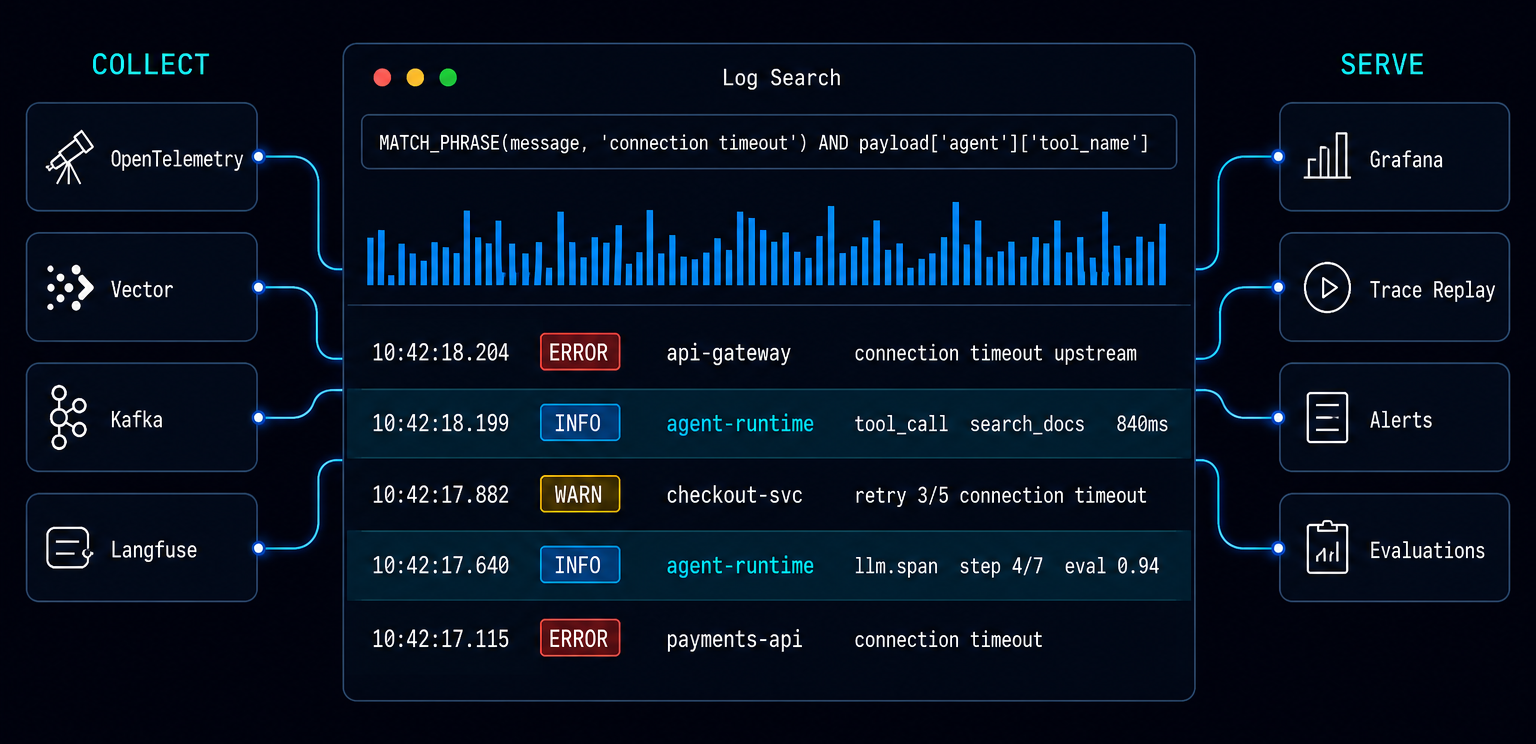
Store application logs, infrastructure metrics, and AI agent traces in one table layout, queried with SQL and full-text search
Ingest deeply nested, constantly changing JSON without ETL, flattening, or mapping explosions
Run phrase search, JSON filters, trace replay, and dashboard aggregations against the same data
Keep full retention with tiered storage: hot data on SSD, history on object storage
Collect with OpenTelemetry, Vector, or Logstash and visualize in Grafana, open source at every layer
VeloDB log search across infrastructure logs and AI agent traces

One engine for agent traces
and infrastructure logs

AI agents produce telemetry data that breaks traditional logging solutions: payloads are much larger, growing from 5 KB to 1 MB, JSON schemas can also evolve with every tool call, and traces that only make sense when replayed in order. VeloDB is designed to handle this new workload and your classic logs, metrics, and traces on the same engine.

Built for agent telemetry
The VARIANT data type stores nested, evolving trace payloads and automatically turns frequent JSON paths into columns. Query payload["tool_call"]["tool_name"] with columnar speed, no schema declared up front.
Search and analytics on the same table
Inverted indexes return keyword matches in milliseconds while columnar storage powers aggregations, and SQL joins correlate logs with metrics and business data for root cause analysis.
Cost that holds at petabyte scale
Columnar storage with ZSTD compression and a simplified inverted index cuts storage to roughly 20% of an Elasticsearch footprint. Tiered storage moves cold data to object storage and cuts unit cost by more than half.
Open at every layer
OpenTelemetry for collection, Grafana for dashboards, MySQL protocol for every SQL client, Apache Doris (Apache 2.0) underneath. Your telemetry stays in open formats you can leave with.
Trusted in production

Observability teams run on VeloDB

MiniMax runs a PB-scale log system for every business line on one architecture, replacing Grafana Loki.

1B
Log records queried in 2s
10GB/s
Write throughput
70%
Storage cost reduction

“Loki scanned full datasets for every regex search and needed a separate deployment per cluster. On Apache Doris, inverted indexes answer a query across 1 billion log records in 2 seconds, one architecture serves every cluster, and availability holds above 99.9%.”

Platform Engineering Team, MiniMax
PB-scale logs, 99.9%+ availability
Read the full story
MiniMaxStepFunNetEaseAdvance.AIKwaiTencent MusicJD.comBaiduMeituanTrip.comMiniMaxStepFunNetEaseAdvance.AIKwaiTencent MusicJD.comBaiduMeituanTrip.com
Real-world tradeoffs

Challenges with Observability
in the Agentic Era

01·Cost
Observability bills now rival the infrastructure they monitor
Elasticsearch-based stacks need 12 to 19x more storage than columnar alternatives.
So teams sample logs, shorten retention, and lose the history they need for debugging and compliance.
Tap to flip
How VeloDB solves it
Full retention at roughly 20% of the Elasticsearch footprint
Columnar storage, a simplified inverted index, and ZSTD compression hold search performance at roughly 20% of the Elasticsearch storage footprint. Writes use 80% less CPU. Tiered storage keeps recent data on SSD and moves history to object storage, so keeping full history fits the budget.
← Flip back
02·Wide JSON
Agent traces and wide JSON break fixed schemas
Agent telemetry is deeply nested JSON with schemas that change constantly, sometimes past 10,000 distinct fields.
Flattening breaks on schema evolution, storing JSON as strings forces full scans, and Elasticsearch answers with mapping explosion.
Tap to flip
How VeloDB solves it
VARIANT stores evolving JSON and reads it as columns
VARIANT stores JSON semi-structured on write and columnar on read, extracting hot paths into real columns automatically. Doris 4.1 handles tables beyond 10,000 JSON fields with deferred shredding, opening segments 16x faster with 60x less memory on ultra-wide tables.
← Flip back
03·Access patterns
Four access patterns collide in a single incident
One investigation needs phrase search over raw text, filters on JSON payloads, ordered trace replay, and live dashboard aggregations.
Teams run a search engine, an OLAP database, and a document store side by side because no one system covers all four.
Tap to flip
How VeloDB solves it
One table layout serves all four access patterns
On AgentLogsBench, a 100-million-trace agent observability benchmark, Apache Doris leads the combined leaderboard: trace replay in 0.020s where ClickHouse takes 2.289s, incident search in 0.088s where Elasticsearch takes 1.116s, and JSON filters in 0.078s where Elasticsearch takes 0.802s.
← Flip back
04·Lock-in
Telemetry locked in closed formats and vendor query languages
Commercial observability platforms hold telemetry behind proprietary formats and query languages.
Costs climb yearly, 36% of enterprise clients now spend over $1M a year on observability, and leaving means rebuilding every dashboard, alert, and saved query.
Tap to flip
How VeloDB solves it
Open at collection, visualization, and engine
The collection layer is OpenTelemetry, with a Doris exporter contributed to the OTel community that auto-creates tables and manages retention from YAML config. The visualization layer is Grafana, connected over MySQL protocol with a dedicated Doris plugin for log discovery and trace views. The engine is open-source Apache Doris.
← Flip back
Architecture overview

VeloDB for observability

Collect once with open agents, ingest continuously, store logs, metrics, and traces in one engine, and serve search, dashboards, and alerts from the same tables.

VeloDB observability engine
Collect
OpenTelemetry
Doris exporter · logs, traces, metrics
Log Shippers
Vector · Logstash · Filebeat · iLogtail
Kafka
Buffer for high-volume pipelines
LLM Instrumentation
Langfuse · LangChain · OpenAI · Claude
Ingest
Routine Load
Continuous consumption from Kafka
Stream Load
HTTP push from services
Auto Table Creation
Retention policies via OTel exporter
Store & Index
Inverted Indexes
MATCH · MATCH_PHRASE in milliseconds
VARIANT
Nested JSON with column extraction
ZSTD Compression
Columnar storage
Tiered Storage
Hot on SSD · cold on object storage
Query
Standard SQL
Over MySQL protocol
Search + Filters
Full-text and structured in one statement
Joins
Correlate logs, metrics, business tables
Trace Replay
Ordered replay and aggregations
Visualize & Act
Grafana
Doris plugin · log discovery · trace views
Alerting
On live aggregations
AI Agents
Fresh telemetry as diagnosis context

Run all your telemetry
on one engine.

Spin up a VeloDB Cloud cluster in under 60 seconds, point an OpenTelemetry Collector at it, and search your first billion log lines with SQL.

Need help? Contact us!