





In modern data systems, speed is no longer just an advantage—it is a requirement. Businesses and applications are expected to react to events as they happen, whether detecting fraud, updating recommendations, monitoring infrastructure, or powering AI systems. This shift has made real-time analytics a foundational capability rather than a specialized feature.
Real-time analytics enables organizations to process and analyze data the moment it is generated, turning continuous data streams into immediate, actionable insight. In practice, it is what allows systems not only to observe what is happening, but to respond while it still matters.
What Is Real-Time Analytics?
Real-time analytics is the process of collecting, processing, querying, and analyzing data immediately as it is generated so teams can make decisions while the data is still operationally useful. In practice, that usually means moving from raw event streams to queryable insight within milliseconds or seconds rather than hours later in a batch cycle.
The important distinction is that real-time analytics is not just about fast ingestion. Plenty of systems can move data quickly. Real-time analytics only becomes real when that data is also queryable, interpretable, and usable for action without delay. While definitions vary, real-time analytics is generally understood as processing and analyzing data with minimal delay.
In practical terms, real-time analytics allows teams to:
- process data continuously as it arrives
- query current data with low latency
- detect patterns, anomalies, or workflow failures quickly
- power live applications, automated systems, and operational decisions
In short, real-time analytics turns streaming data into action. It performs best when the value of the data drops quickly over time, such as fraud detection, observability, personalization, or AI workflows that depend on fresh context. It is less valuable when the use case is purely historical reporting and can tolerate delay.
Why Real-Time Analytics Matters
Real-time analytics matters because modern systems are increasingly judged by how quickly they respond to change, not just by how much data they store. In many applications, data loses value fast. A fraud signal that arrives too late is not a useful fraud signal. A recommendation based on yesterday’s behavior is weaker than one based on the current session. A retrieval system that cannot surface fresh context in time is no longer helping the model reason about the present.
That is why the issue is not simply speed for its own sake. The real issue is decision quality. When systems operate on stale data, they often appear functional while quietly making worse decisions.
Faster decision-making
Instead of waiting for batch reports or delayed warehouse refreshes, teams can respond to events when they still matter. This is especially important in operations, fraud prevention, alerting, and live AI workflows.
Better customer experience
Real-time personalization depends on understanding user behavior as it happens. If the data arrives too late, the experience becomes reactive rather than adaptive.
Operational visibility
Monitoring systems, logs, traces, and infrastructure signals become much more useful when teams can query them while incidents are unfolding. This is one of the clearest differences between live observability and retrospective reporting.
AI-driven systems
Modern AI applications, especially RAG systems and LLM Observability workflows, depend on fresh and continuously updated data. Real-time analytics helps make that data queryable fast enough to support retrieval, monitoring, debugging, and system optimization.
The practical lesson is that real-time analytics matters most when delay changes the outcome. If a business or product decision becomes weaker after a few seconds, minutes, or event cycles, the analytics layer becomes part of the application itself, not just part of the reporting stack.
How Real-Time Analytics Works
Real-time analytics is not a single tool. It is a coordinated pipeline that moves data from generation to action. The reason many systems fail is not because one component is missing, but because one layer in that chain cannot keep up with the others.
A simplified flow looks like this:
Data Sources → Ingestion → Processing → Storage & Analytics → Query → Action
Each stage serves a different purpose, and understanding that role separation helps clarify where bottlenecks usually emerge.
1. Data collection
Real-time analytics begins with continuously generated data. This often includes application logs, user interactions, IoT telemetry, clickstreams, APIs, and event streams. The diversity of sources matters because real-time systems rarely work with a single clean data type.
2. Data ingestion
The ingestion layer moves data into the system as it is produced. Streaming technologies such as Kafka are commonly used here because they can absorb high event volume and decouple producers from downstream consumers.
3. Stream processing
Before data becomes useful, it often needs to be cleaned, transformed, enriched, or filtered. This is where stream processing frameworks such as Flink come in. They help shape raw events into data that downstream systems can query more effectively.
4. Storage and analytics layer
This is the core layer in real-time analytics. It is where data stops being “in motion” and becomes something teams can actually query, filter, aggregate, and investigate. In practice, this is the layer that determines whether the system can deliver real-time insight or only near-real-time reporting.
Modern real-time analytical databases such as VeloDB, built on Apache Doris, are designed for this layer. They are typically evaluated on how well they support high-throughput ingestion, low-latency analytical queries, and high-cardinality event data under production load.
5. Query and visualization
Once data is queryable, teams use SQL, dashboards, APIs, or embedded applications to analyze it. This is where monitoring dashboards, internal ops tools, product analytics views, and AI system debugging interfaces become possible.
6. Action
The point of real-time analytics is not to produce a nice chart a few seconds faster. It is to trigger action. That action may be an alert, an automated workflow, a recommendation update, a fraud block, or an AI system decision based on live context.
A useful way to remember the full flow is this: streaming systems move the data, processing systems shape it, and the analytics layer makes it useful. If the final query layer is too slow, the whole pipeline stops behaving like a real-time system even if ingestion looks impressive on paper.
Real-Time Analytics Architecture (Modern Systems)
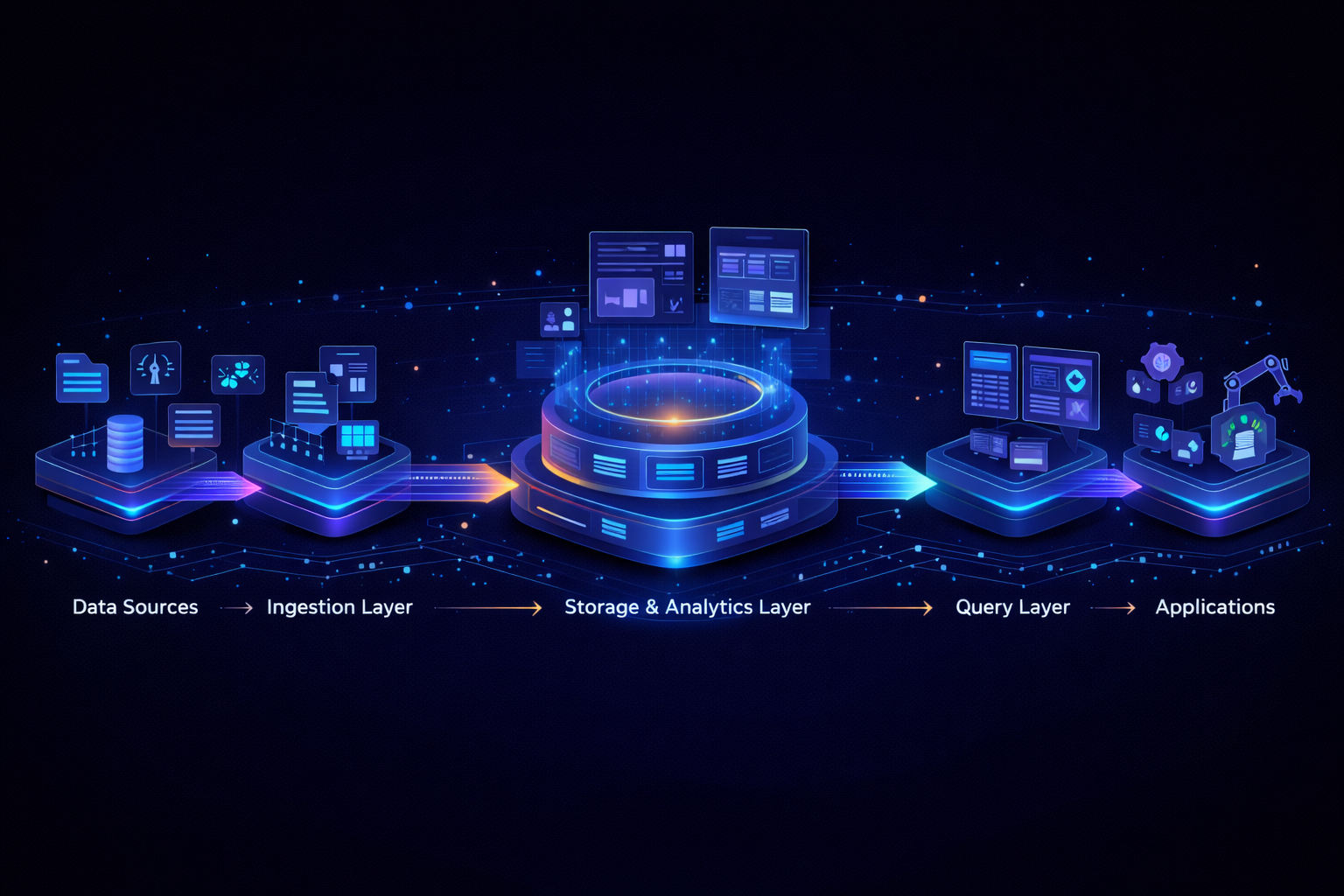
A modern real-time analytics architecture is layered, but the layers matter for a practical reason: each one solves a different bottleneck. Teams often think they have a real-time system because they added a stream processor or a message bus. In reality, the system only becomes real-time when all the layers work together without introducing query delay, data backlog, or operational fragmentation.
A typical architecture looks like this:
Data Sources → Ingestion Layer → Processing Layer → Storage & Analytics Layer → Query Layer → Applications
That sequence is helpful because it makes one thing clear: data movement, data transformation, and data analysis are not the same job. When teams collapse those responsibilities mentally, they often choose the wrong tool for the wrong layer.
Data sources
This layer includes logs, clickstreams, transactional events, IoT telemetry, API payloads, database changes, and user behavior streams. These sources are often heterogeneous, which means the architecture must handle both velocity and variety from the beginning.
Ingestion layer
The ingestion layer is responsible for moving live data into the system reliably and continuously. Kafka is a common example because it buffers event streams, absorbs bursty traffic, and decouples producers from downstream systems. In practice, this layer determines whether the pipeline can keep up with incoming volume without data loss or downstream pressure spikes.
Processing layer
This is where filtering, transformation, enrichment, deduplication, and routing happen. Tools such as Flink help shape raw events before they reach the analytics layer. This stage matters because bad data enters the system fast too. If the processing layer is weak, the analytics layer ends up querying noisy or poorly structured events, which reduces the value of every downstream decision.
Storage and analytics layer
This is the architectural turning point and usually the most decisive layer in the whole stack. It is where fresh data becomes queryable, aggregatable, and operationally useful. Without a high-performance analytical database here, even the best ingestion and processing stack still produces delayed insight.
This layer determines:
- how quickly fresh data becomes queryable
- whether queries stay fast under concurrency
- how well the system handles high-cardinality operational data
- how much extra infrastructure is needed around the core analytics engine
In practice, this is where systems either become production-grade or quietly degrade into “near real-time” reporting.
Query layer
This is where users, dashboards, services, or AI systems actually interact with the data. SQL, APIs, dashboards, and embedded analytics interfaces all sit here. If this layer is too slow, too limited, or too expensive to query at scale, the rest of the architecture stops feeling real-time to the people who depend on it.
Applications and actions
The final consumers include dashboards, alerting systems, recommendation engines, operational tooling, AI systems, and automated workflows. This layer is where insight turns into action, which is why latency at earlier stages matters so much.
Most real-time analytics systems do not fail because teams forgot to ingest data. They fail because one of three things happens: the processing layer becomes too complex, the analytics layer cannot query fresh data fast enough, or too many separate systems are stitched together and become operationally fragile. That is why the storage and analytics layer deserves more attention than it usually gets. It often decides whether the rest of the architecture can actually deliver on the promise of real time.
The most important architectural lesson is that “real-time” is not guaranteed by the presence of Kafka or another streaming tool. Real-time analytics becomes real only when the storage and analytics layer can absorb fresh data and still serve useful queries under actual production conditions.
Real-Time Analytics vs Batch Analytics
| Aspect | Real-Time Analytics | Batch Analytics |
|---|---|---|
| Data Processing | Continuous (streaming data) | Periodic (scheduled jobs) |
| Latency | Milliseconds to seconds | Minutes to hours |
| Data Ingestion | Streaming ingestion (Kafka, event streams) | Bulk ingestion (ETL pipelines) |
| Query Performance | Low-latency queries on fresh data | Optimized for large-scale historical queries |
| Data Freshness | Near-instant updates | Delayed (based on schedule) |
| Scalability | Requires distributed real-time systems | Easier to scale for batch workloads |
| System Complexity | High (multi-layer architecture) | Lower (simpler pipelines) |
| Cost | Higher due to continuous processing | Lower for large-scale offline processing |
Real-time analytics and batch analytics are often treated like competing labels, but they solve different timing problems. The better way to compare them is by asking how quickly the business or system needs to act on the data.
Batch analytics is designed for scheduled processing, historical reporting, and retrospective analysis. Real-time analytics is designed for continuously changing data and low-latency decision support.
If the article includes a comparison table, it should show at least these distinctions: latency, freshness, processing mode, query expectations, cost tradeoffs, and best-fit use case. In prose, the core difference is simple: batch helps explain what happened, while real-time helps systems respond to what is happening.
When to Use Real-Time Analytics
The best way to decide whether you need real-time analytics is to ask how much the value of the data declines with delay. If waiting minutes or hours makes the signal less useful, real-time analytics is probably justified. If the insight is mostly historical and strategic, batch is often enough.
Use real-time analytics when:
- AI systems need fresh context for retrieval, monitoring, or decision-making
- monitoring and observability workflows depend on live querying
- user-facing applications need instant personalization or ranking updates
- alerts, fraud signals, or anomaly detection lose value quickly over time
Use batch analytics when:
- the main goal is reporting
- the analysis is historical rather than operational
- the workload can tolerate delayed refresh cycles
A common mistake is forcing real-time infrastructure into workflows that do not need it, or forcing batch systems into workflows that clearly do. Good architecture decisions usually start with this timing question rather than with a tool comparison.
Real-Time Analytics vs Streaming Analytics
These two terms are closely related, which is why they are often mixed together, but they describe different responsibilities in a modern data stack. Streaming analytics is primarily concerned with data in motion. Real-time analytics is concerned with making that data useful for decisions through low-latency querying and analysis.
The distinction matters because many teams invest heavily in stream processing and then assume they have solved the analytics problem. In reality, they have only solved the transport and transformation part of the pipeline.
In practical terms:
- streaming systems focus on ingestion, movement, routing, and transformation
- real-time analytics systems focus on querying, filtering, aggregating, and investigating fresh data
A useful way to understand the difference is to ask two different questions:
- Can the system process events continuously as they arrive?
- Can the system answer useful questions on those events fast enough for action?
The first question is about streaming. The second is about real-time analytics.
For example, Kafka and Flink can move and process an event stream efficiently, but they are not the place most teams want to run interactive analytical queries. A real-time analytics database is what turns that processed stream into something a dashboard, alerting engine, or AI system can actually query without friction.
This is also why some architectures look real-time on paper but feel slow in practice. The stream is fast, but the queryable layer is weak. When that happens, teams have a strong data pipeline but not a strong real-time analytics system.
Real-Time Analytics Use Cases
Real-time analytics shows up most clearly in use cases where delay weakens the result. That is the common pattern across industries. The label may differ, but the operational logic is the same: the system needs fresh, queryable data while the decision window is still open.
The following use cases are common, and each one highlights a different reason real-time analytics matters.
Fraud detection
Fraud systems need to evaluate suspicious behavior while the event window is still active. A payment anomaly, login pattern, or account action only matters if the system can detect it in time to intervene. If the analytics layer lags, the model may still produce a correct judgment, but too late to prevent loss.
Recommendation systems
Recommendations perform best when they reflect current user behavior rather than yesterday’s profile. Real-time analytics helps update rankings, offers, and content suggestions while the user is still in session. That matters because user intent shifts quickly, especially in ecommerce, media, and content products.
IoT monitoring
IoT environments generate constant telemetry from sensors, devices, and equipment. Real-time analytics helps surface anomalies, performance drift, and operational health issues before they escalate into larger system failures. In these environments, a delayed signal is often operationally equivalent to a missed signal.
Real-time personalization
Pricing, offers, notifications, and content adaptation become much stronger when they are based on live behavior rather than stale snapshots. This is one of the clearest cases where analytics directly affects user experience rather than merely informing a report.
LLM observability
LLM systems continuously generate prompts, responses, traces, latency data, tool-call events, and token usage signals. Real-time analytics helps teams inspect those systems while issues are still unfolding, which is especially important when debugging hallucinations, latency regressions, or workflow failures in production AI environments.
Operational monitoring and incident response
Real-time analytics is also central to observability-heavy engineering workflows. Teams need live access to logs, metrics, and traces so they can investigate incidents while the system state is still meaningful. This is where the difference between a retrospective dashboard and a live analytics layer becomes obvious.
Across all of these examples, the shared requirement is not simply “more data.” It is fresh data that can be queried quickly enough to support an action. That action may be blocking fraud, changing a recommendation, detecting device failure, debugging an AI system, or responding to an incident. The use case changes, but the timing requirement does not.
Challenges of Real-Time Analytics
Real-time analytics creates obvious value, but it also introduces practical challenges that teams underestimate when looking only at architecture diagrams.
- High infrastructure cost: continuous ingestion and querying can become expensive quickly.
- Large data volume and velocity: live event streams create sustained pressure on ingestion and query systems.
- System complexity: most real-time stacks involve multiple layers that must stay aligned under load.
- Data consistency tradeoffs: systems often need to balance freshness, correctness, and performance.
One of the most common failure points is the query layer. Many real-time systems do not fail because data cannot be ingested. They fail because the data cannot be queried quickly enough once the volume and concurrency become real.
Best Real-Time Analytics Tools (Compared)
Choosing the right tool depends less on broad claims like “fast” or “scalable” and more on what role the tool plays in the architecture. Some systems move data. Some process it. Some make it queryable. Comparing them without that context creates confusion.
The most useful way to compare real-time analytics tools is by role, workload fit, and operational tradeoff.
VeloDB
VeloDB is best understood as the core real-time analytical database layer for workloads where fast ingestion and low-latency querying need to happen in the same system. Its advantage becomes most visible when teams are dealing with high-cardinality operational data such as logs, traces, events, metrics, or AI workflow telemetry and cannot afford to split ingestion, storage, and analytics across too many separate components.
What makes VeloDB particularly compelling is not just raw speed. It is the combination of speed, concurrency handling, and architectural consolidation. In many real-world systems, the biggest problem is not that data arrives too slowly. It is that once the data arrives, teams still need a separate set of systems to query it effectively, enrich it, and keep it operationally useful at scale. VeloDB is strongest when that complexity is the real bottleneck.
Best for:
- AI applications
- real-time dashboards
- observability systems
- teams that need one system to support ingestion and querying together
Strengths:
- real-time ingestion and querying in a single system
- strong performance on high-cardinality data
- good fit for observability, streaming, and AI workloads
This makes VeloDB a strong fit for teams that care as much about operational simplicity as they do about query speed. However, it is most differentiated when the workload is genuinely real-time and analytics-heavy, rather than primarily warehouse-style reporting.
ClickHouse
ClickHouse is one of the strongest choices when the priority is high-performance analytical querying on large datasets. It has a strong reputation for speed and is widely adopted in engineering-heavy environments.
Best for:
- high-performance analytics
- internal dashboards
- log analytics at scale
Strengths:
- extremely fast analytical queries
- strong ecosystem and adoption
- efficient for large-scale analytical workloads
This makes ClickHouse a strong fit when raw analytical performance is the main decision factor. However, teams should still account for the engineering effort required to manage surrounding ingestion, orchestration, or operational complexity at scale.
Apache Pinot
Apache Pinot is especially well suited to event-driven, user-facing analytics where low-latency querying over fresh event data is central to the product experience.
Best for:
- event-driven analytics
- product metrics
- user-facing analytical applications
Strengths:
- designed for low-latency event queries
- strong fit with streaming ecosystems
- good choice for real-time user-facing metrics
This makes Pinot a strong fit when the workload is clearly centered on event analytics. However, teams should assess whether they also need a broader analytics layer for more varied workloads.
The Future of Real-Time Analytics
The future of real-time analytics is not just faster dashboards. It is a broader shift in how modern systems are built. As software becomes more event-driven, AI-assisted, and automation-heavy, analytics is moving closer to the point of action. That means the real-time analytics layer is increasingly becoming part of the application runtime rather than a reporting layer behind it.
Several trends are driving that change, but they all point in the same direction: teams need fresher data, faster queries, and fewer architectural handoffs between ingestion, analysis, and action.
AI-driven analytics
AI systems are accelerating demand for real-time analytics because they rely on fresh context, live feedback, and continuous evaluation. Retrieval systems, observability pipelines, and agent workflows all become weaker when the analytics layer lags behind the system state. This is one reason real-time analytics is increasingly being discussed alongside AI infrastructure rather than only alongside dashboards.
Agent-based systems
As software agents begin making more multi-step decisions, the system needs to sense and react to changing conditions continuously. In these architectures, analytics is no longer something humans look at later. It becomes part of how the system reasons in the moment.
Real-time-first architectures
More teams are designing for real-time from the start rather than trying to retrofit it onto batch systems later. That changes the architecture conversation. Instead of asking whether a pipeline can move data quickly enough, teams are increasingly asking whether the data can stay queryable and useful under real operating conditions.
Convergence toward unified platforms
The market is also moving toward architectures that reduce the number of separate systems needed to ingest, store, and analyze live data. This does not mean every organization will adopt a single tool. It does mean the cost of fragmented stacks is becoming more visible, especially when observability, AI telemetry, event analytics, and dashboard workloads start to overlap.
The most important long-term shift is that real-time analytics is no longer a premium optimization or a niche capability for a few high-scale companies. It is becoming a foundational layer for software that needs to sense, decide, and adapt continuously. For readers evaluating tools and architecture today, that means the real question is not whether real-time analytics will matter. It is whether the stack they choose now can support where the workload is clearly heading next.
FAQs
What are examples of real-time analytics?
Common examples include fraud detection, live dashboards, recommendation systems, IoT monitoring, observability, and RAG-based AI systems that depend on fresh context.
Why are traditional data warehouses not suitable for real-time analytics?
Traditional data warehouses are mainly designed for batch processing and historical analysis. They often struggle with high-frequency ingestion, low-latency querying, and operational workloads that require fresh data to be queryable immediately.
Conclusion
Real-time analytics is the process of turning continuously generated data into immediate, queryable insight so systems can respond while the signal still matters. Its real value appears in environments where delay weakens outcomes, such as observability, AI workflows, personalization, and operational decision-making.
The most important architectural lesson is that ingestion alone is not enough. The storage and analytics layer is what determines whether the system can truly support real-time decisions. That is also why choosing the right tool matters: the best system is not the one that simply moves data fastest, but the one that can make fresh data usable under real production conditions.