





A leading global cryptocurrency exchange runs real-time trading analytics behind live services for trading, real-time dashboards, and ops or compliance reporting.
The exchange decided to move its real-time trading analytics from Hologres to VeloDB to get better query performance on less hardware.
Results: After migrating to VeloDB, the exchange's new cluster runs on 60% fewer CPU cores, runs queries 700% faster, and handles twice the write throughput, while keeping query latency under 50 ms and data freshness within 3 seconds at a 70,000 TPS ingest peak.
Challenges: high performance on less hardware
Crypto exchanges deal with high data volumes, and the volume does not arrive evenly. A sharp price move in the market can multiply order flow within seconds, and that is exactly when traders, risk teams, and operators most need current numbers.
The exchange streams every event (order, trade, and account) through Apache Kafka. Its analytics layer has to process the stream in real time, make it queryable almost immediately, and serve interactive queries fast enough for live services.
The exchange's performance requirements, including at the peak of a spike:
-
Ingest: 70,000 TPS. Peak write rate from Kafka, sustained through market spikes without backlog.
-
Freshness: within 3 seconds. An event needs to be queryable within 3 seconds of landing in Kafka.
-
Latency: under 50 ms. Per query, for the real-time services that read from the analytics layer.
Hologres met these targets, but it operated on a large and costly CPU footprint. As trading volume grew, the exchange needed a platform that could keep the same guarantees while using far less hardware.
From Hologres to VeloDB: new architecture
New architecture after moving to VeloDB:
-
Publish: The exchange uses matching engine, order management, and wallet and settlement services to write every trade, order update, and account event to Kafka topics.
-
Ingest: VeloDB, a real-time search and analytics database built on Apache Doris, consumes those topics continuously and commits small batches every second or so, keeping up with a 70,000 TPS peak.
-
Upsert: VeloDB's Merge-on-Write tables resolve updates to the same order or account at write time, so teams can see the latest state, with no merge work at query time.
-
Serve: Analytics services query VeloDB with standard SQL over the MySQL protocol and get answers in under 50 ms. Downstream consumers include a trading analytics API, real-time dashboards, risk and surveillance, and ops or reporting.
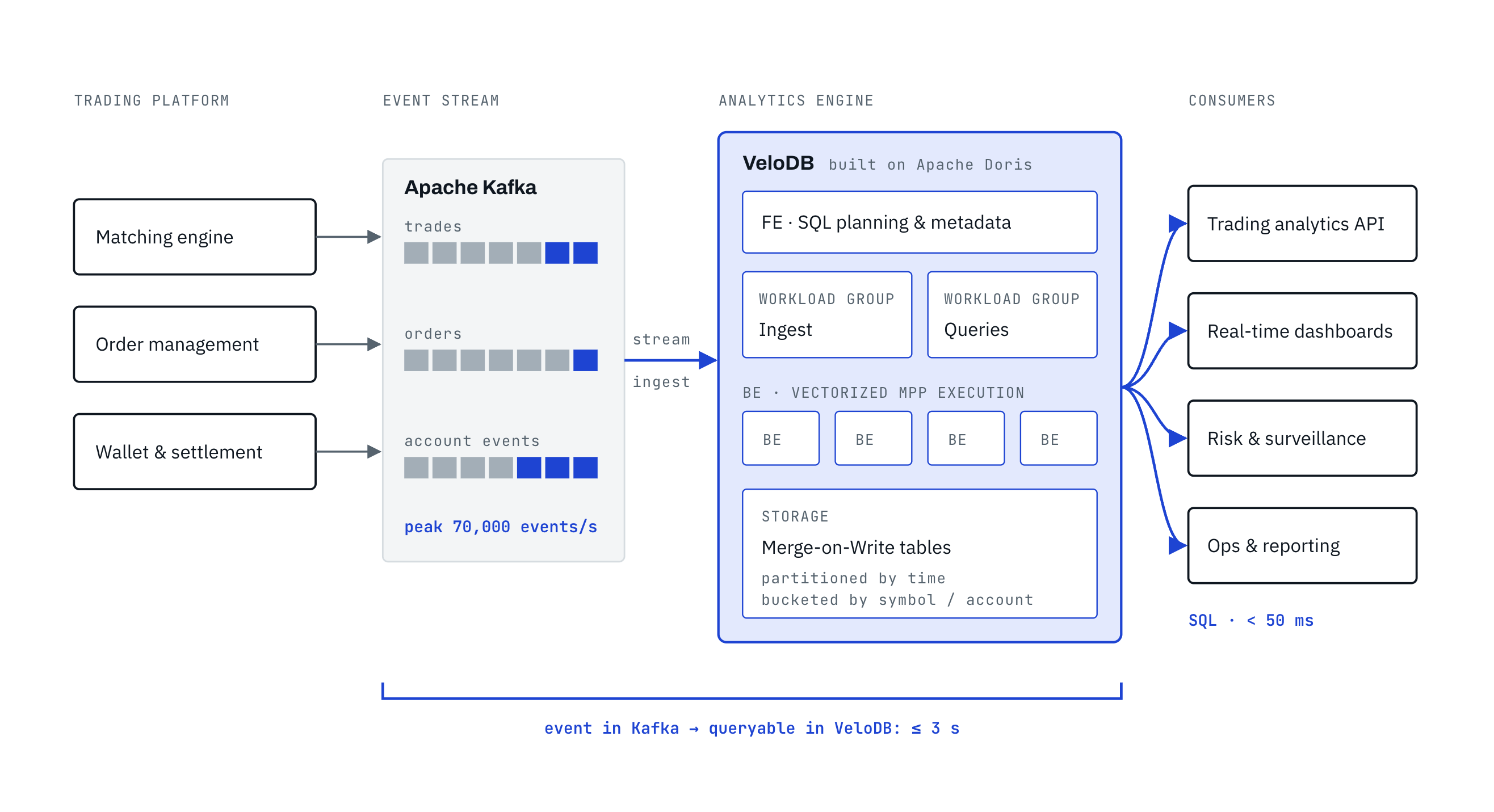
The new architecture runs a single streaming path, delivering 700% faster queries on 60% less compute and keeping freshness within 3 seconds.
Within that 3-second freshness window, ingestion matters even more than query speed, because ingestion actually makes up most of the window. The image below shows how ingestion and query share that 3-second window. At under 50 ms, the query itself uses only about 1.7% of the window. Most of it belongs to ingestion, which is why sustained write throughput matters as much as raw query speed.

Key VeloDB engine features
Several VeloDB capabilities, built on Apache Doris, are what let the smaller cluster deliver better performance:
-
Merge-on-Write unique key tables: An order’s status can change many times over its life. Merge-on-Write marks the old row as deleted at write time, so queries scan only current rows and keep their speed on constantly updated data. Learn more about VeloDB's Merge-on-Write and its real-time update feature.
-
Native streaming from Kafka: VeloDB's Routine Load and group commit turn a high-rate stream into frequent, small, transactional commits. This allows data to become visible within seconds without flooding storage with tiny versions.
-
Vectorized MPP execution: Columnar, SIMD-friendly execution spreads each query across the backend nodes. More work gets done per core, which is how a smaller cluster outruns a larger one.
-
Partitions, buckets, and indexes: Time partitions, symbol and account buckets, sort-key prefix indexes, and inverted indexes let a query read only the data it needs. A lookup on one trading pair over the last hour touches a small slice of the table.
-
Workload groups: Ingest and queries run in separate resource groups. A burst of writes during a sell-off cannot starve the queries that dashboards and risk checks depend on.
-
Synchronous materialized views: Rollups such as per-minute OHLCV candles and per-symbol volume stay current with every write, and the optimizer rewrites matching queries to use them.
Summary
The crypto exchange needed every trade visible in seconds and every query back in milliseconds, and it needed both to run on less hardware. After the move from Hologres to VeloDB, the team kept the 3-second freshness and sub-50 ms query SLAs, ran the same workload on 60% fewer CPU cores, sped up queries by 700%, and doubled write throughput, with headroom left at a 70,000 TPS peak.
As volume grows, that extra ingest capacity is what lets the platform absorb the next asset price surge without adding a matching amount of hardware.
To learn more about running real-time analytics on VeloDB, contact the VeloDB team, or join the Apache Doris community.