





Real-time analytics platforms have moved from “nice to have” to core infrastructure for modern data-driven products. Whether you are building customer-facing dashboards, monitoring operational systems, or powering real-time decisioning, the choice of analytics platform directly affects latency, cost, and user experience.
Many real-time analytics platforms exist today, but only a handful are widely used for large-scale, low-latency analytical workloads.
The most widely used real-time analytics platforms in 2026 include:
- VeloDB – best for customer-facing analytics and high-concurrency serving workloads
- ClickHouse – a high-performance OLAP database optimized for large-scale event analytics
- Elasticsearch – popular for search-driven analytics over semi-structured data
- Apache Druid – widely used for time-series analytics and operational dashboards
- Apache Pinot – designed for user-facing analytics with sub-second query latency
Each platform is optimized for different workloads depending on latency requirements, concurrency, data freshness, and operational complexity.
The rest of this guide explains how these systems differ and how to choose the right real-time analytics platform for your architecture.
What Are Real-Time Analytics Platforms?
Real-time analytics platforms are systems designed to ingest, process, and query data with minimal delay, allowing users or applications to act on fresh data rather than historical snapshots.
Unlike traditional analytics systems that rely on batch pipelines and periodic refreshes, real-time analytics platforms emphasize:
- Continuous or near-continuous data ingestion
- Low-latency analytical queries
- High concurrency for interactive workloads
- Support for operational and customer-facing use cases
Not every real-time analytics platform excels at all of these dimensions. Some systems focus primarily on ingestion and stream processing, while others are optimized for interactive querying and high-concurrency serving. Understanding where a platform sits along this spectrum is critical when evaluating it for real-world workloads.
In practice, “real-time” does not mean zero latency. It means the system is fast enough that data is still actionable when queried, often within seconds—or sub-seconds in systems designed for interactive serving workloads—depending on the underlying architecture.
Core Components of Real-Time Analytics Platforms
Most real-time analytics platforms follow a similar architecture designed to ingest, process, and query streaming data with minimal delay.
In practice, a modern real-time analytics architecture typically consists of three core components:
1. Streaming Ingestion
Streaming ingestion systems collect high-volume event data from applications, services, and devices in real time. Technologies such as Apache Kafka and Amazon Kinesis are commonly used to handle continuous data streams and deliver them reliably to downstream analytics systems.
2. Stream Processing
Stream processing frameworks transform, filter, and enrich data as it arrives. Tools such as Apache Flink and Spark Streaming allow teams to compute metrics, join event streams, and prepare data for analytical queries before it is stored.
3. Analytical Storage and Query Engines
The final layer is the analytical engine responsible for storing and querying data with low latency. Columnar analytical databases such as VeloDB, ClickHouse, Apache Pinot, and Apache Druid are commonly used to power interactive dashboards, operational analytics, and user-facing data applications.
Together, these components allow real-time analytics platforms to move data from ingestion to insight within seconds or even sub-seconds.
Why Real-Time Analytics Platforms Matter in 2026
Real-time analytics has become critical due to three structural shifts in how software systems are built and used.
1. User Expectations Have Changed
Modern users expect dashboards, metrics, and insights to update immediately. Whether it is revenue tracking, usage analytics, or operational status, delays of minutes—or even seconds—can break trust and engagement.
This is especially true for customer-facing analytics. If a customer logs in and sees numbers that look stale, the product feels unreliable—even if the underlying system is technically correct.
Static reports are no longer sufficient for customer-facing analytics or operational decision-making.
2. Systems Are Increasingly Event-Driven
Applications now generate continuous streams of events from microservices, IoT devices, user interactions, and APIs. Batch-oriented systems struggle to keep up with this velocity without introducing complexity and delay.
More importantly, modern systems don’t just produce events—they often depend on them. Feature flags, billing, personalization, fraud scoring, and monitoring pipelines all rely on streaming data.
Real-time analytics platforms are designed to operate on data as it flows, not after it settles.
3. Decisions Are Moving Closer to the Data
Fraud detection, personalization, monitoring, and automation all require decisions to happen while data is fresh. In many cases, delayed insight is equivalent to no insight at all.
This shift has pushed analytics systems closer to production workloads. As a result, the “analytics database” is no longer a passive reporting tool—it becomes part of the application’s runtime behavior. That raises the bar on:
- Performance under load
- Reliability and fault tolerance
- Cost predictability
- Operational simplicity
In 2026, real-time analytics is no longer a niche category. It’s becoming part of the default infrastructure for data-driven SaaS products.
How to Choose the Right Real-Time Analytics Platform
Not all real-time analytics platforms are built for the same problems. Before comparing tools, it helps to evaluate platforms across a small set of practical dimensions.
The biggest mistake teams make is selecting platforms based on one metric (for example, “fastest query benchmark” or “cheapest storage”). Real-time analytics is a system problem. You need to evaluate how the platform behaves under real production constraints: high concurrency, continuously changing data, and unpredictable workloads.
Below are the most important factors to focus on.
1. Data Freshness and Query Latency
Look beyond marketing claims. Ask:
- How fresh is data end to end?
- What is the typical and P95 query latency under load?
Fresh data is only useful if queries return fast enough to support interaction. A system that ingests in real time but answers queries in 5 seconds may still feel “not real-time” for dashboards and APIs.
2. Concurrency and Multi-Tenant Support
Dashboards and APIs often generate thousands of concurrent queries. Platforms that perform well in single-user benchmarks may degrade quickly under fan-out workloads.
Concurrency is especially critical for customer-facing analytics, where you can’t control query patterns and where every user expects fast responses at the same time.
3. Update and Mutation Support
Some platforms are optimized for append-only data. Others support real-time updates, deletes, and CDC.
If your data changes over time—orders update, statuses flip, users change plans, devices go offline—this distinction matters. Many “real-time” systems quietly assume immutable event logs, which can be a mismatch for real business entities.
4. Operational Complexity and Cost Drivers
Real-time systems are always on. Understanding what drives cost (compute, storage, queries, ingestion) and how complex the system is to operate can prevent painful surprises later.
For example:
- Some systems are cheap to store data in, but expensive to query at scale
- Some systems have excellent performance, but require heavy tuning and deep operational expertise
- Some platforms bundle ingestion + processing + storage, but lock you into a specific ecosystem
In practice, the best platform is the one that fits your workload with the least operational overhead, not the one with the most features on paper.
5 Real-Time Analytics Platforms in 2026
Before diving into individual reviews, the table below compares VeloDB, ClickHouse, Elasticsearch, Apache Druid, and Trino/Pinot across key dimensions such as query latency, real-time ingestion, and concurrency.
| System | Best For | Data Freshness (End-to-End) | Query Latency (Typical / P95) | Concurrency (Dashboards / Multi-tenant) | Real-Time Updates | SQL Support | Operational Complexity | Cost Driver |
|---|---|---|---|---|---|---|---|---|
| VeloDB | Customer-facing & operational real-time analytics | Sub-second to seconds | <100 ms (interactive) | High (10k+ QPS) | Yes (primary key, CDC-friendly) | Full ANSI SQL (MySQL-compatible) | Medium | Storage + queries |
| ClickHouse | High-performance OLAP on event data | Seconds | <200 ms (tuned) | Medium–High (needs tuning) | Async mutations (merge-based) | SQL-like (ClickHouse dialect) | Medium–High | Compute + storage |
| Elasticsearch | Search-driven analytics & log/event exploration | Seconds (near-real-time indexing) | Seconds (heavy aggregations) | Medium | Expensive (reindex/update API) | Query DSL + SQL (limited joins) | Medium–High (cluster tuning) | Indexing + storage + memory |
| Apache Druid | Time-series & streaming event dashboards | Seconds (stream ingestion) | Hundreds of ms | High (dashboard workloads) | Append-oriented (limited mutation) | SQL layer (Druid SQL) | Medium–High | Ingestion + storage tiers |
| Trino / Pinot | Federated SQL (Trino) / Low-latency event serving (Pinot) | Seconds (Trino via sources) / Sub-seconds (Pinot real-time) | Depends on sources (often seconds) (Trino) / <100 ms (Pinot) | Medium (Trino) / High (Pinot) | Depends on backend (Trino) / Upserts supported (limited) (Pinot) | ANSI SQL (Trino) / SQL-like (Pinot) | Medium (Trino) / Medium–High (Pinot) | Compute (Trino) / Storage + serving nodes (Pinot) |
1. VeloDB (Apache Doris–based)
 VeloDB is an enterprise real-time analytics platform built on Apache Doris, designed as a unified analytical engine for both interactive serving workloads and large-scale data warehousing. In other words, it’s the kind of system you use when analytics is no longer just internal reporting, but something users or operational teams interact with continuously. Typical workloads include customer-facing analytics, real-time and historical data warehousing, observability analytics and real-time analytical backends for AI-driven applications where query latency and concurrency matter as much as data freshness.
What sets VeloDB apart is that it brings fast SQL, high-concurrency serving, real-time updates, and native search into a single engine. Search is not treated as a separate subsystem: full-text, structured filtering, and vector search run in the same execution engine, backed by built-in index types and the same vectorized execution engine used for analytical queries. This matters because many analytics databases perform best when data is append-only. In real products, however, business entities change constantly—orders update, users change plans, device status flips, and late events arrive. VeloDB is built to handle these “mutable analytics” patterns without forcing teams to rebuild tables in batch.
【Capabilities & Features】
- Low-latency analytical queries: Designed for sub-second SQL queries on large datasets, including high-cardinality dimensions.
- High concurrency at scale: Supports dashboard fan-out and multi-tenant workloads where thousands of users query simultaneously.
- Real-time updates (upserts): Merge-on-write architecture with delete bitmaps supports CDC-style updates and changing entity data.
- Flexible indexing: Columnar storage plus inverted indexes enable fast filtering and “needle-in-haystack” queries.
- SQL and tool compatibility: MySQL protocol + standard SQL make it easy to integrate with BI tools and backend services.
- Semi-structured analytics: Native VARIANT support makes it practical to query evolving telemetry and event payloads without constant schema migrations.
【Pros】
- Strong balance of freshness + query speed + concurrency
- Upserts and CDC are natively supported
- SQL-first experience that fits both BI and app queries
【Cons】
- Not meant to replace OLTP databases
- Requires distributed OLAP operational knowledge at scale
【Pricing】
Commercial licensing with enterprise support and managed deployment options. Cost is typically driven by cluster size, storage footprint, and query workload.
【When to Choose VeloDB】
Choose VeloDB when:
- You need sub-second queries for customer-facing dashboards
- Your data changes frequently and requires real-time updates
- You want SQL analytics, search, and vector retrieval in one engine
- Your system must support high concurrency and multi-tenant workloads
2. ClickHouse
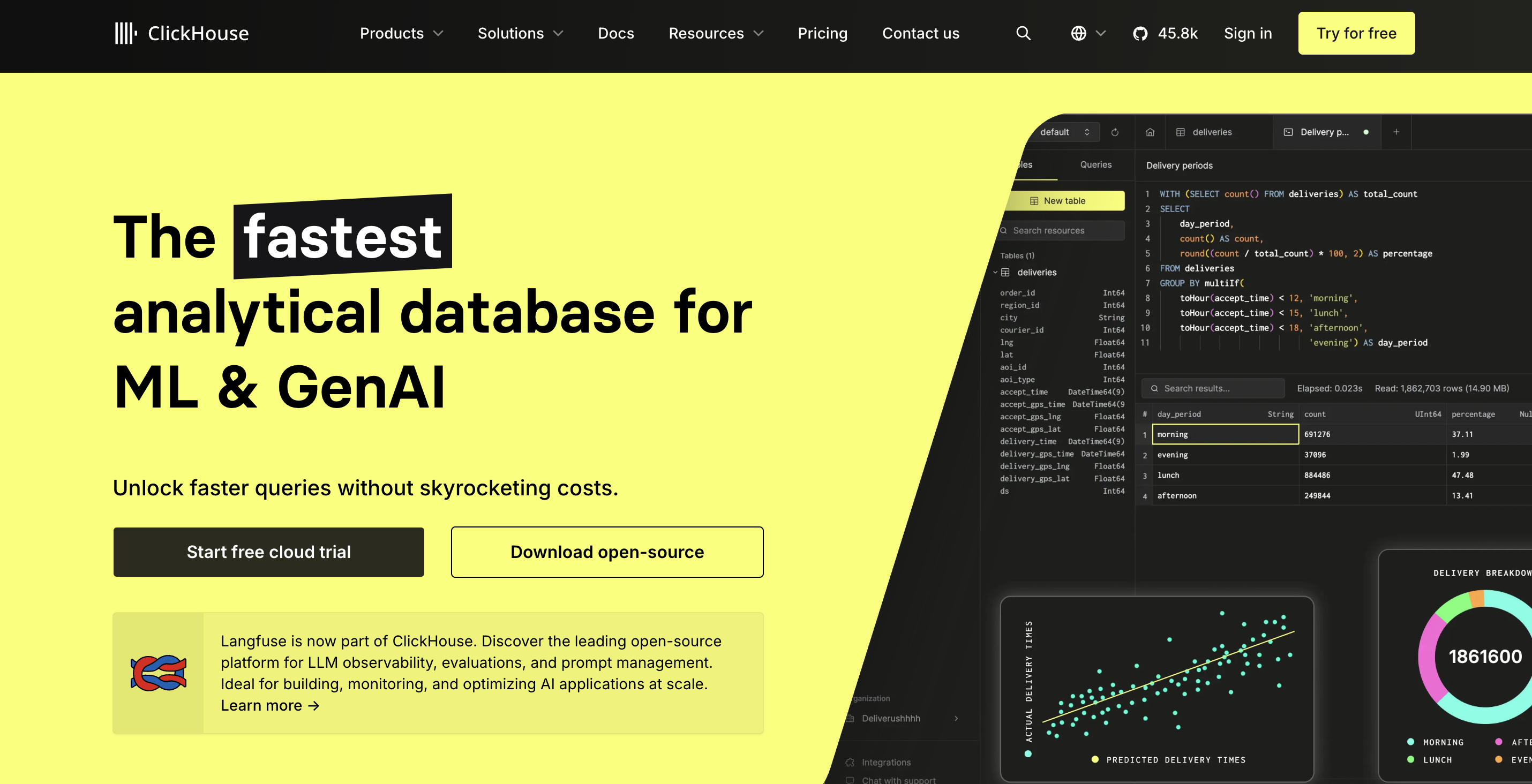 ClickHouse is an open-source columnar OLAP database best known for its raw analytical performance. It’s often the first choice when teams need to scan and aggregate massive volumes of event data—logs, metrics, clickstreams—at very low cost and with impressive speed. In many organizations, ClickHouse starts as an internal analytics engine used by engineers and data teams for exploration and troubleshooting.
Where ClickHouse really shines is append-heavy workloads with predictable schemas and time-based access patterns. However, as analytics move closer to end users and dashboards become more interactive, teams often need to invest additional effort to manage concurrency, updates, and operational stability.
【Capabilities & Features】
- High-performance OLAP engine: Columnar storage + vectorized execution optimized for scans and aggregations.
- Efficient compression: Strong encoding and compression reduce storage footprint and improve scan speed.
- Fast time-series analytics: Well-suited for time-window queries, rollups, and event-based metrics.
- Flexible ingestion options: Often ingests from Kafka via Kafka Engine + materialized views, or through external streaming pipelines.
- Rich analytical SQL dialect: Supports many OLAP-style functions, aggregations, and approximate queries.
- Distributed scaling: Supports sharding and replication across clusters for large datasets.
【Pros】
- Extremely fast for large-scale analytical queries
- Strong open-source ecosystem and community adoption
- Excellent storage efficiency for event data
【Cons】
- Updates and deletes rely on mutations and merges, which can be expensive at scale
- High-concurrency dashboard workloads require tuning
- Cluster operations become complex at large scale
【Pricing】
Open source (infrastructure + ops cost) with optional managed services. Costs are typically driven by compute, storage, and query intensity.
3. Elasticsearch
 Elasticsearch is primarily known as a search engine, but it is widely used as a real-time analytics backend for log analytics, operational dashboards, and search-driven analytics applications. Its architecture is optimized for near-real-time indexing and flexible querying over semi-structured data, which makes it attractive for event-heavy and search-centric workloads.
In real-time analytics scenarios, Elasticsearch works best when filtering, full-text search, and faceted exploration are central to the user experience. It is particularly strong when data is document-oriented and when analytical queries resemble search queries more than heavy relational joins.
However, Elasticsearch is not optimized for high-concurrency SQL-style analytics workloads. As workloads shift toward complex aggregations or multi-tenant dashboard traffic, cluster tuning and resource management become critical.
【Capabilities & Features】
- Near-real-time indexing: Tunable refresh intervals make newly ingested data quickly searchable.
- Full-text + structured search: Combines inverted indexing, filtering, and aggregations on document-based data.
- Powerful aggregation framework: Supports group-by, percentiles, histograms, top-N queries, and faceted analytics.
- Schema-flexible document model: Handles semi-structured and evolving event payloads without rigid schema constraints.
- Horizontal scalability: Shard-based distribution with replication for high availability and large datasets.
- Lifecycle and tiering support: Hot, warm, and cold data tiers help balance performance and storage cost.
【Pros】
- Excellent for search-driven analytics use cases
- Handles semi-structured and evolving schemas well
- Strong ecosystem and production maturity
【Cons】
- High memory and storage overhead at scale
- Complex cluster tuning under heavy analytical workloads
- Limited support for relational-style joins and complex SQL
【Pricing】
Open source with infrastructure and operational costs, plus commercial Elastic offerings. Costs are typically driven by shard count, indexing volume, and storage tiering.
4. Apache Druid
 Apache Druid is a distributed, column-oriented data store designed specifically for real-time analytics and time-series workloads. It was built to handle high-ingestion event streams and support low-latency aggregations on large datasets, making it popular in operational analytics, ad tech, and product analytics use cases.
Druid separates ingestion, storage, and query nodes, which allows it to scale ingestion and querying independently. It performs particularly well for time-based rollups, slicing across dimensions, and dashboard-style analytics with predictable query patterns.
However, Druid is optimized around event-style, append-heavy data models. Real-time updates, complex joins, and non-time-based analytical patterns are less natural fits.
【Capabilities & Features】
- Real-time streaming ingestion: Ingests continuously from Kafka and other streaming systems with low-latency availability.
- Columnar storage engine: Optimized for fast aggregations and time-based analytical queries.
- Time-based partitioning and rollups: Reduces storage footprint and accelerates common dashboard queries.
- High-concurrency query processing: Designed for slice-and-dice exploration across large event datasets.
- SQL query layer: Provides SQL support on top of Druid’s native execution engine.
- Tiered storage architecture: Separates ingestion, query, and historical nodes for scalable deployments.
【Pros】
- Strong performance for time-series and event analytics
- Efficient at high ingestion rates
- Good fit for operational dashboards
【Cons】
- Less flexible for complex joins or relational modeling
- Row-level mutation support is more constrained than append-first OLAP designs
- Operational complexity across ingestion and query tiers
【Pricing】
Open source with infrastructure and operational costs. Managed services are available, typically priced based on cluster size, ingestion throughput, and storage tiers.
5. Trino (Federated SQL) / Apache Pinot (Real-Time OLAP)
 Trino and Apache Pinot represent two different approaches to real-time analytics, but they are often evaluated in similar architectural discussions.
Trino is a distributed SQL query engine designed for federated analytics across multiple data sources. It does not store data itself; instead, it queries data lakes, object storage, and external databases in place. This makes it powerful for unifying batch and streaming data across systems, but less optimized for ultra-low-latency serving workloads.
Apache Pinot, on the other hand, is a distributed OLAP store designed for real-time user-facing analytics. It is commonly used in product analytics and event-driven applications where low-latency, often sub-second query performance is required over streaming data. Pinot supports hybrid tables (real-time + offline segments), making it suitable for continuously updated dashboards.
The choice between them depends on whether you need a federated query engine (Trino) or a purpose-built real-time serving store (Pinot).
【Capabilities & Features】
Trino
- Distributed MPP SQL engine: Executes parallel queries across large datasets.
- Federated query support: Connects to data lakes, object storage, Kafka, and relational databases.
- Separation of storage and compute: Fits lakehouse-style architectures.
- Strong ANSI SQL compatibility: Supports complex joins and cross-source analytics.
- Connector-based ecosystem: Extensible integration across heterogeneous systems.
Apache Pinot
- Real-time stream ingestion: Consumes directly from Kafka with low-latency availability.
- Low-latency OLAP engine: Optimized for low-latency, often sub-second query performance.
- Hybrid table model: Combines real-time and offline segments.
- Built-in indexing options: Inverted and star-tree indexes accelerate filter + aggregation queries.
- High-concurrency support: Designed for user-facing event analytics workloads.
【Pros】
- Trino: Excellent for cross-system analytics and lakehouse queries
- Pinot: Very low latency for user-facing event analytics
- Both: Strong open-source ecosystems
【Cons】
- Trino: Not designed as a low-latency serving layer
- Pinot: Less flexible for complex joins and heavy relational workloads
- Both: Require operational expertise at scale
【Pricing】
Both are open source. Costs are driven by infrastructure, storage, ingestion throughput, and cluster size. Managed services are available depending on provider.
Emerging Trends in Real-Time Analytics Platforms
By 2026, real-time analytics platforms are evolving beyond simply delivering faster dashboards. The focus is shifting toward making analytics more proactive, more accessible, more distributed, and more tightly integrated with application serving layers.
1. Agentic AI Integration (Autonomous Analytics Agents)
More platforms are beginning to experiment with agentic AI, integrating autonomous agents that continuously monitor real-time data streams. Instead of relying on users to check dashboards or configure complex alerts, AI agents can automatically detect meaningful changes—such as inventory shortages, demand spikes, pricing anomalies, or operational risks—and surface insights or recommendations. This shifts analytics from a reactive reporting tool into an always-on decision assistant.
2. Natural Language Query (Analytics Without SQL)
Natural language querying is moving from demos into real product workflows in real-time analytics platforms. Users can ask questions in plain language, and the system translates them into analytical queries, runs the analysis on fresh data, and returns both results and explanations. This significantly lowers the barrier to real-time analytics, enabling operations, growth, and business teams to explore data without writing SQL.
3. Edge Analytics (Processing Data Closer to the Source)
As IoT and 5G adoption increases, more real-time analytics is moving to the edge. Edge analytics allows data to be processed, aggregated, and analyzed near where it is generated—such as on factory machines or remote sensors—reducing latency and bandwidth usage. Cloud platforms still provide global visibility and historical analysis, but real-time decisions increasingly happen closer to the data source.
In practice, this often means pushing lightweight aggregation to the edge, while using a centralized real-time analytics platform for global querying and long-term retention.
4. Hybrid Search + Analytics (Analytics as a Retrieval Backend)
Real-time analytics platforms are increasingly expected to support more than just SQL aggregations. As AI-driven applications become mainstream, many teams now look for a single system that can power both analytical queries and retrieval-style workloads—such as filtering, keyword search, and semantic search.
This has led to growing interest in hybrid architectures where structured analytics, full-text search, and vector similarity search can be performed on the same fresh dataset. Instead of maintaining separate systems for OLAP, search, and vector retrieval, teams are looking for platforms that can serve as a unified backend for real-time dashboards, operational investigation, and AI-powered user experiences.
This emerging direction is described as Hybrid Search and Analytical Processing (HSAP)—an architectural approach where analytics engines evolve into unified retrieval backends capable of supporting SQL analytics, keyword search, and vector similarity queries on the same dataset.
In practice, this trend reflects a broader shift: analytics engines are moving closer to application serving layers, where they support not only reporting, but also real-time exploration and retrieval in production workflows.
Final Thoughts
There is no single “best” real-time analytics platform—only platforms that fit different workloads.
If you need low-latency, high-concurrency analytics with real-time updates, VeloDB and ClickHouse are often the best fit for serving-style workloads. For search-first analytics over semi-structured event data, Elasticsearch is a practical choice. For streaming event analytics and fast time-series aggregations, Apache Druid remains a proven option. And if your goal is either federated analytics across multiple systems (Trino) or ultra-low-latency user-facing event analytics (Apache Pinot), those engines can be a better match.
The right choice comes down to your real constraints: freshness, latency, concurrency, and whether your data is append-only or constantly changing.