- Products
- SolutionsUse Cases
Real-Time Analytics
Sub-second dashboards and data products on petabytes of data at any concurrency
Data Warehousing
Sub-second analytics on open lakehouse formats with no vendor lock-in
Observability in the AI Era
The most cost-effective alternative to Elasticsearch observability
Context Engineering
Hybrid search and fresh context for RAG, agents, and LLMs
IndustriesFinancial Services
Real-time analytics and fraud detection for banking, capital markets, and on-chain data
Ad & Media tech
Advertiser-facing reporting, content search, and game telemetry on one engine
Automobile & Transportation
Fleet telemetry, real-time recommendations, and multimodal autonomous driving search
- Docs
- Resources
- Pricing
- Contact us






Scaling Real-Time Analytics From PostgreSQL
Stream every change from the Postgres WAL in about one second
Serve live dashboards and data APIs for thousands of concurrent users
Run multi-table joins, full-text search, and vector search in a single engine
Submit your product and service requirements,
our team will respond within 1 business day.
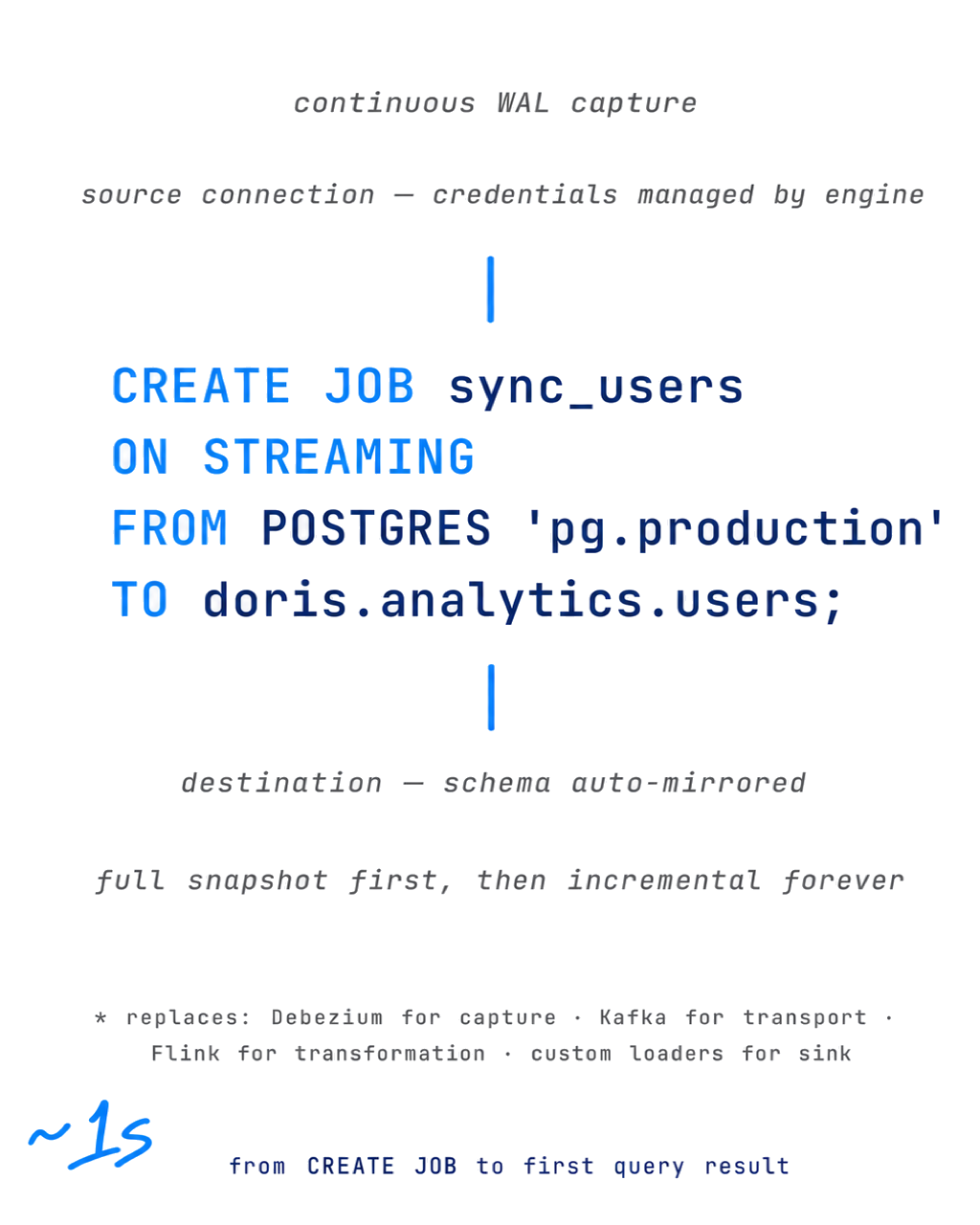
Sync Postgres to analytics with one SQL statement
Traditional change data capture chains Debezium, Kafka, and Flink together just to move rows from Postgres into an analytical engine. That is three systems to deploy, monitor, and scale for what is really a single job.
VeloDB replaces the entire pipeline with one CREATE JOB statement. It reads the Postgres write-ahead log directly, loads a full snapshot on the first run, and then streams every change after that. Schema updates propagate on their own, and new rows are queryable in about one second.
See how native PostgreSQL CDC works in Doris 4.1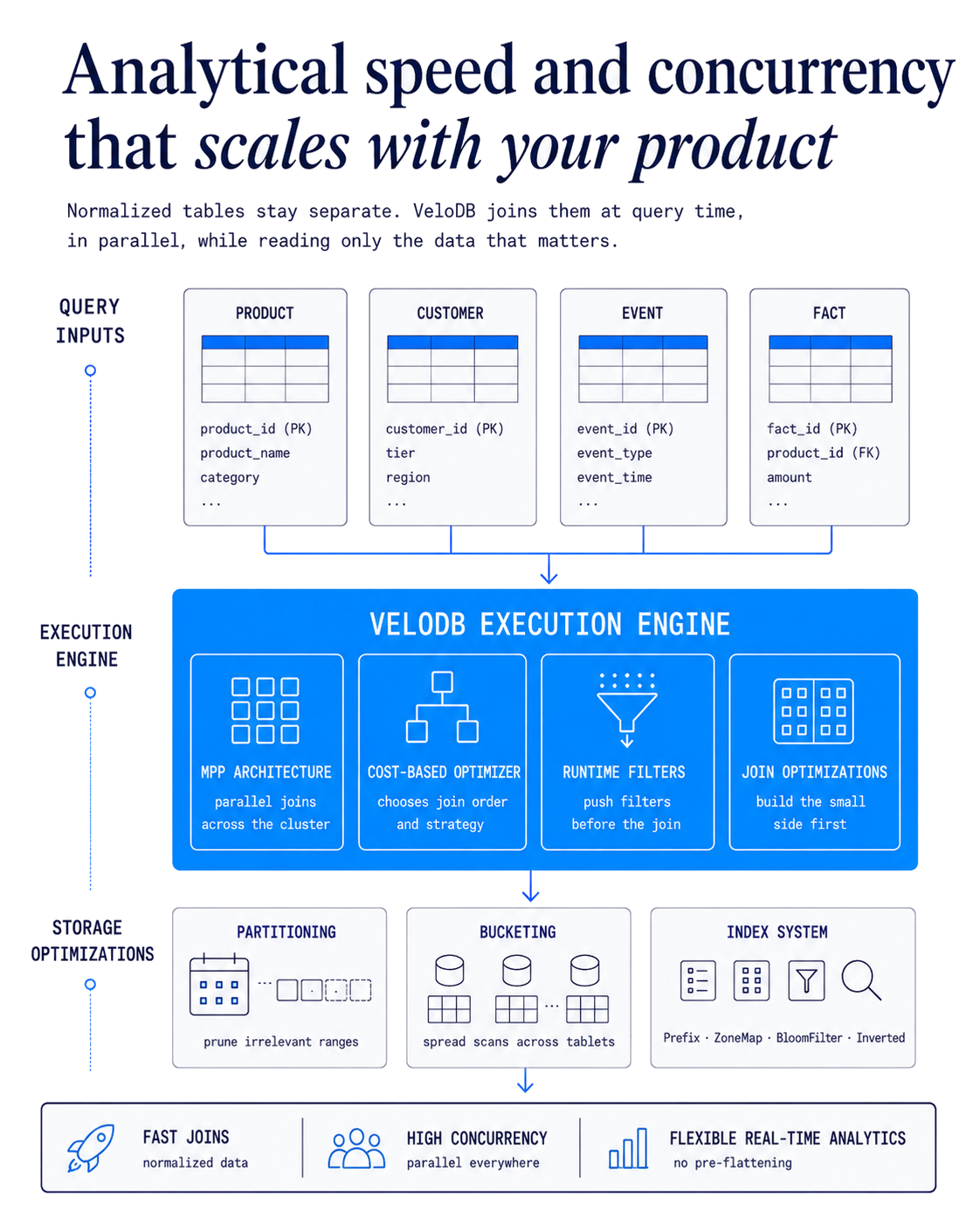
Fast multi-table joins at high concurrency
A Postgres read replica still stores rows on a single node, so each query reads whole rows and complex joins run one core at a time. Adding replicas raises cost without making any single query faster.
VeloDB stores the same tables in columns and runs every query in parallel across the cluster. A cost-based optimizer chooses the join strategy, runtime filters drop irrelevant rows before the join, and Merge-on-Write keeps reads fast as data changes. Postgres keeps handling transactions while VeloDB serves analytics at any level of concurrency.
See how JD.com serves 10,000 analytical queries per second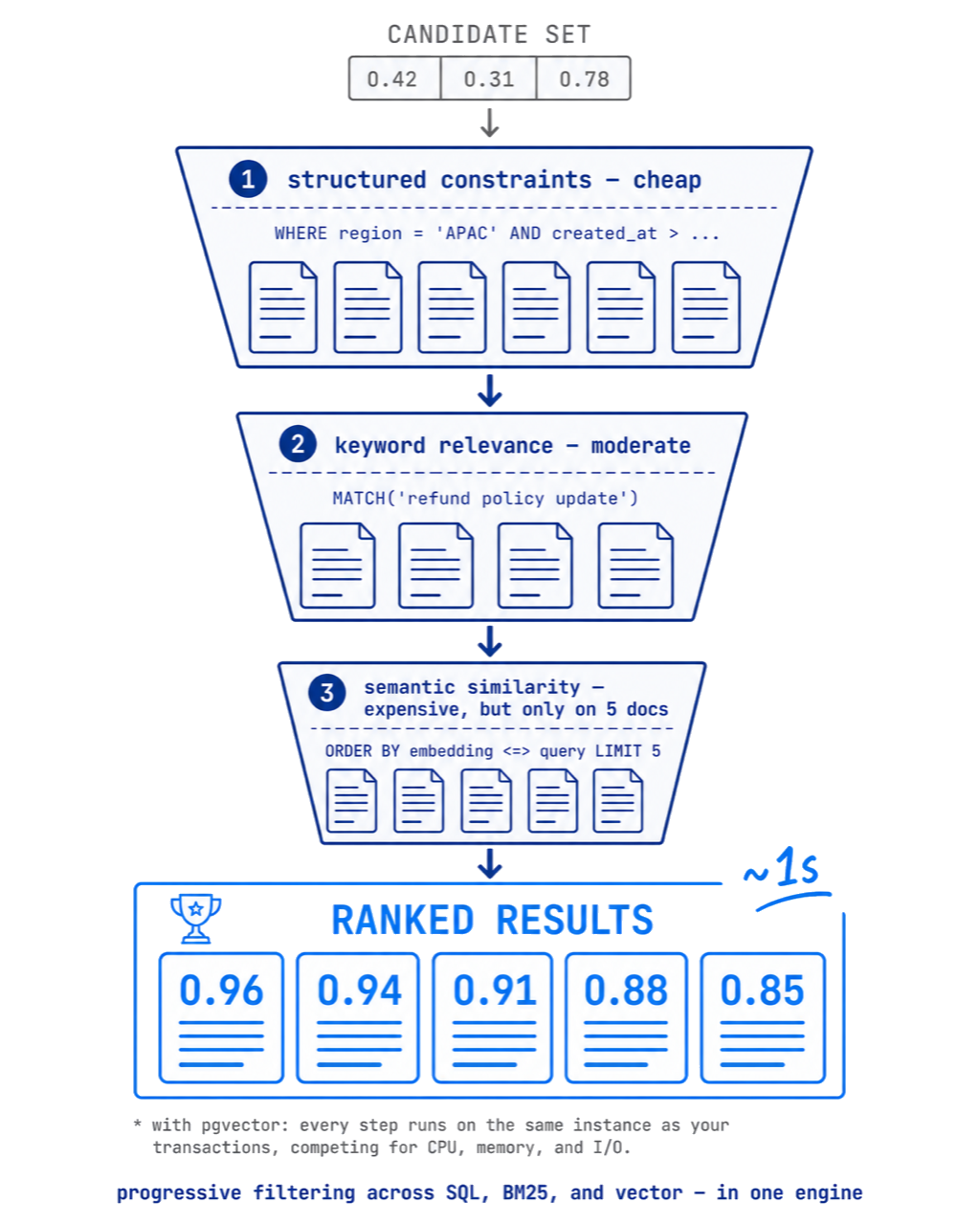
Hybrid search across SQL, full-text, and vector
pgvector adds similarity search to Postgres, but it shares the same CPU, memory, and disk as your transactions. At scale, vector scans compete with production queries, and there is no way to shrink the candidate set before the expensive step runs.
VeloDB runs the workload on its own engine and filters in stages. SQL constraints narrow the rows first, BM25 keyword scoring ranks what remains, and vector similarity runs last on the small subset that survives. Because the most expensive step touches the least data, relevance goes up while cost comes down.
Read about progressive filtering in Doris 4.0