





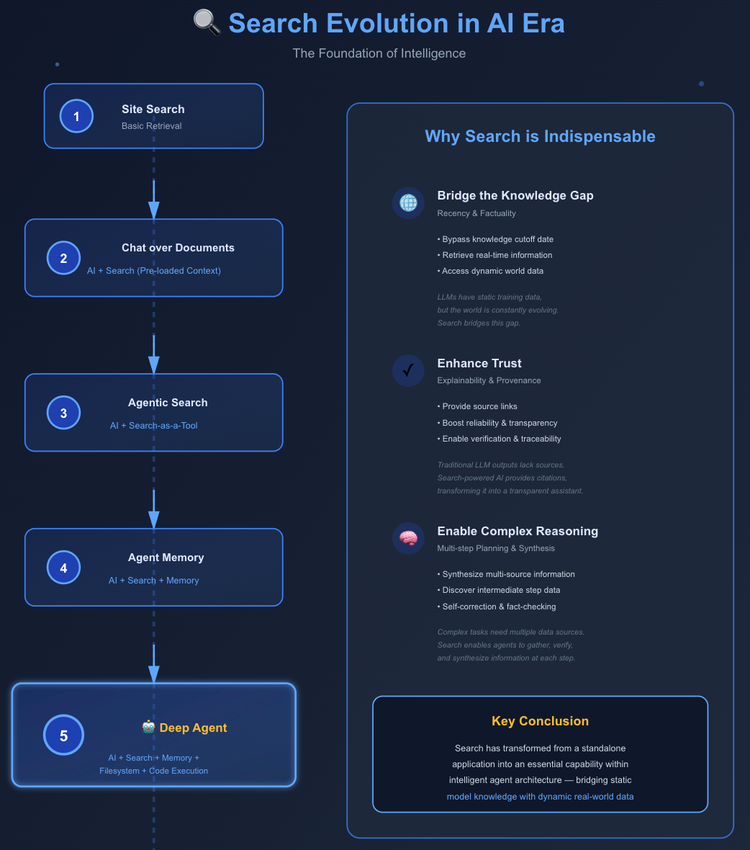
The rapid evolution of Artificial Intelligence (AI), particularly Large Language Models (LLMs), has brought forth impressive generative and reasoning capabilities. However, as your image clearly illustrates, from the most basic "Site search" to the complex "Deep agent," the ability to search remains a fundamental and indispensable component for building powerful and practical AI systems. In the AI era, search is no longer just a retrieval function; it has been elevated to a critical augmentation tool for the intelligent agent.
I. Search as the Key Pattern in AI Agent Evolution
The "Key patterns" listed in your image demonstrate a clear progression of how the Search capability is integrated and amplified within AI agents:
1. Basic Retrieval and Context Enhancement
- Site search: The simplest form, relying purely on traditional search technology to retrieve information.
- Chat over documents: This marks the entry of AI: . The AI uses search techniques to quickly locate relevant information within a set of pre-loaded, often private or specific, documents. This dramatically enhances the accuracy and relevance of Q&A by overcoming the traditional LLM problems of "knowledge cutoff" and "hallucination."
2. The Agentic Leap
- Agentic search: The pattern evolves to . Here, Search is treated as an explicit tool that the AI can decide when and how to use to aid in its reasoning and decision-making. This enables the AI to handle real-time or up-to-the-minute information that is beyond its training data.
- Agent memory: . Search is used not only for external data but is often employed to perform efficient retrieval within the agent's internal memory store to recall past interactions or experiences.
3. Towards the Deep Agent
With the strategic addition of Memory, Filesystem, and Code execution, the centrality of Search is cemented:
- Agent planning: . In complex, multi-step tasks, the Search capability allows the agent to quickly find necessary resources, files, or historical data to support its planning and execution flow.
- Deep agent: The ultimate architecture, encompassing . Search acts as the information, knowledge, and toolchain connector, ensuring the agent always has access to the most relevant, timely, and correct information to guide its code execution and complex reasoning.
II. Why Search is Indispensable in the AI Era
The importance of Search in the age of AI can be summarized by three core functions:
1. Bridging the Knowledge Gap (Recency and Factuality)
All LLMs possess static knowledge based on their training data. The world, however, is dynamic, with new events, data, and discoveries emerging constantly. By integrating Search as a real-time tool into the AI workflow, the agent is empowered to:
- Bypass the Knowledge Cutoff Date.
- Retrieve up-to-the-minute information, thus providing timely and accurate advice or answers.
2. Enhancing Trust and Explainability
Traditional LLM outputs often lack provenance. When an AI utilizes Search to gather information, it can provide the user with the source links used for its conclusion. This is vital because it:
- Significantly boosts the reliability of AI's response.
- Provides explainability, allowing the user to trace the information back to its original source for verification, turning the AI from a black box into a transparent research assistant.
3. Enabling Complex Reasoning and Planning
Complex tasks require synthesizing information from multiple sources; the agent cannot rely solely on its internal parametric knowledge. Search allows AI to:
- Discover data needed for intermediate steps. For example, an agent tasked with writing a report on a recent market event must first use Search to retrieve the latest market data.
- Perform self-correction and fact-checking. At every step of reasoning, the AI can employ Search to verify its assumptions or intermediate conclusions, ensuring the final output is logically and factually sound.
Conclusion:
In the AI era, Search has transitioned from a standalone application to an essential capability within intelligent agent architecture. It is the bridge that connects static model knowledge with dynamic real-world information, serving as the foundation for improving AI's accuracy, recency, trustworthiness, and ability to handle complexity. The future of AI is intrinsically tied to the deep integration of powerful LLM reasoning with robust search capabilities.